
The market is smart, but it doesn’t see everything
Insiders know their company’s true value
When they invest their own money, it’s a signal the market hasn’t priced in yet
ExecBuy turns those signals into an edge
1. What is Insider Trading?
Insider trading is the legal, regulated purchase of shares by company leadership. We track the moves of those who know the company best.
- Canada (SEDI): Filed within 5 calendar days
- USA (SEC): Filed within 2 business days
2. Filtering the Noise
Open Market Only
- We ignore grants and options. If they aren’t putting their own cash on the line, it doesn’t count
Materiality
- We track all transactions but focus on buys over $25K — where conviction is strongest and signals are clearest
Exchange Focus
- We track the TSX and the top 2,800 US companies on the NYSE and NASDAQ, filtering out “penny stock” volatility
Role Hierarchy
- CEO and CFO buys are statistically the strongest signals of future performance
“Insiders might sell their shares for any number of reasons, but they buy them for only one: they think the price will rise.”
3. Our Signature “Insider Signals”
We categorize trades into specific “Signal Profiles.” Some are stronger than others; understanding the context is key to identifying a winning trade.
| Signal | Description | Strength |
|---|---|---|
| High Conviction | CEO / CFO buys >$100K + 5% increase in holdings | 🟢 Very High |
| Cluster Buy | 3+ distinct insiders bought in 30 days | 🟢 High |
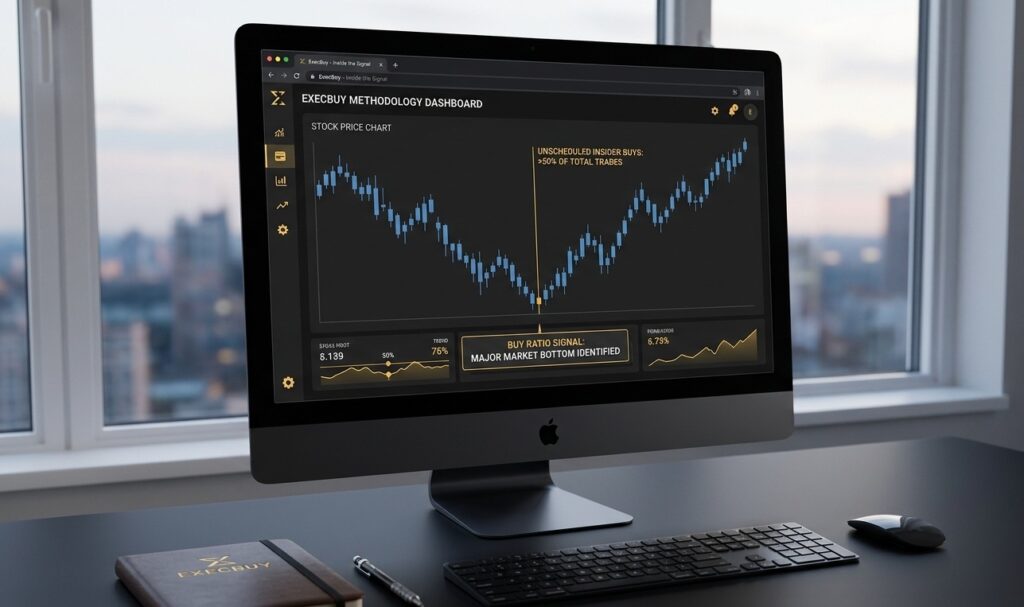
| Near 52-Week Low | The “Bottom Fisher” signal. Buying at the trough | 🟡 Medium |
| Large % Change | Position expansion of 5% or more | 🟡 Medium |
| Rapid Rebuy | Buying on 3+ separate days in a month | 🔴 Low |
| Short Squeeze Setup | Net buying while Short Interest is rising | 🔴 Speculative |
4. Behavioral Patterns: How Insiders Trade
Value Seekers: Insiders buy when the market overreacts to the downside
The Early Bias: They have long horizons. Their buying marks the “floor,” not necessarily an immediate spike
Lead Indicators: Use these as signals to start your research, not as blind instructions
The time of maximum pessimism is the best time to buy, and if insiders are buying during that pessimism, the signal is even stronger.
5. Grounded in Academic Research
Our methodology isn’t just theory; it is backed by decades of financial literature.
Executive Hierarchy (Seyhun, 1986/1998)
Established that trades by the most senior leaders (CEO/CFO) are the most predictive signals for future stock price appreciation (link)
The 12-Month Edge (Lakonishok & Lee, 2001)
Confirmed that while the market is slow to react, high-conviction insider portfolios significantly outperform over a one-year horizon (link)
Misvaluation Sensitivity (Jenter, 2003)
Found that executives are highly effective at identifying and buying when the market fundamentally undervalues their company’s prospects (link)
Opportunistic Alpha (Cohen et al., 2012)
Isolated “opportunistic” (unscheduled) trades, finding they generate abnormal returns of 82 basis points per month (link)
Anchoring Bias (Lasfer, 2024)
Showed that insiders exploit market fear at 52-week lows, with their “bottom-fishing” purchases significantly beating the broader indices (link)